Disability Insurance
SuperLife disability insurance protects you from the loss of income from a severe disability that prevents you from working for an extended period.

SuperLife disability insurance protects you from the loss of income from a severe disability that prevents you from working for an extended period.
KiwiSaver isn't complicated. But like most things worth having, it rewards a little attention at the right moments.
Whether retirement is decades away or just around the corner, your investment timeframe is one of the most important factors when choosing how your KiwiSaver is invested.
The two things that matter most are how much you're contributing, and which fund you're in. Together, they determine how hard your money is working. Someone in the wrong fund for their age, or contributing less than they could, may be leaving thousands of dollars behind - quietly, over years, without ever noticing.
Getting both right doesn't require a financial degree. It just requires a check-in every now and then.
The good news is that the SuperLife KiwiSaver Scheme is built to flex with you - with the ability to change your investment strategy whenever your circumstances change.
Here's a common sense guide to getting the most from your KiwiSaver at every stage.
In your 20s | In your 30s | | In your 40s | In your 50s | Approaching 65
Time is on your side
Retirement feels a long way off. It is. That's actually the point. Time is actually your biggest advantage - and right now, you have more of it than anyone.
The reason time is the most powerful force in investing, is because of compounding - the way returns build on returns and on your contributions, year after year.
The earlier you start, the harder your money works, and the less you have to contribute later to reach the same outcome.
What this means for you:
KiwiSaver is generally locked until age 65 with limited exceptions such as first home withdrawals.
A simple way to think about it is balancing growth and stability.
If your money is invested too aggressively, you may experience larger ups and downs and uncertainty for your KiwiSaver amount when you need to draw it down. However, too conservatively over the long term will result in lower growth potential, where your KiwiSaver savings may struggle to keep up with rising costs.
The longer you have before you need your money, the more time you have to ride out market ups and downs. If your timeframe is shorter, stability matters more.
It comes down to two things: when you're likely to need access to your money, and how comfortable you are with your balance going up and down along the way.
While age is a useful guide, your fund choice should also reflect your personal circumstances, goals and comfort with risk.
What to focus on in your 20s:
The key action is being in the right KiwiSaver fund and contributing consistently.
With SuperLife, you can choose a fund, or funds that match where you are now - and change at any time with no switching fees. You can choose from diversified funds or build your own portfolio from over 40 funds or choose Age Steps, which automatically adjusts your mix of growth and income assets as you get older.
Life gets complicated, but don't pause
Your 30s are often when life gets busy - careers, children, competing financial priorities such as a mortgage. It's also when KiwiSaver can quietly slip down the priority list.
But what you do in this decade can have a real impact over time. Compounding works best when it isn't interrupted - so gaps in contributions, while sometimes unavoidable, are worth making up when you can.
If you've taken a KiwiSaver withdrawal for your first home, it's worth getting contributions back on track as soon as you can. If you’ve chosen a more stable fund choice leading up to your first home purchase, it’s a good time to review your fund options as you start saving for retirement.
If you took a savings suspension - perhaps during parental leave or a career change - consider whether you're ready to restart. Even a small voluntary top-up can make a big difference over time.
What to focus on in your 30s:
Time to take stock
By your 40s, most people start paying more attention to their KiwiSaver. Retirement might still be a while away, but the decisions you make now carry real weight.
This is a good decade to sit down and do some planning. How much do you have? What might you need? What are your options between now and 65?
What to focus on in your 40s:
Getting focused
Retirement might not be a date yet, but it isn't just a vague concept anymore.
With retirement potentially 10 -15 years away, you still have time for your money to grow.
This is often the decade where it might make sense to regularly review your fund mix as you get closer to retirement age. There is no single “right” option - it's about what best fits your situation and how comfortable you are with market ups and downs. Your investment strategy can be changed at any time, with no switching fees.
For many investors, keeping your savings invested and growing after reaching retirement age may help ensure you’ve got a steady retirement income from your KiwiSaver for a longer period rather than drawing it down all at once when you can.
What to focus on in your 50s:
Knowing your options
KiwiSaver doesn't end at 65 - it simply changes.
From age 65, you're eligible to access your savings. However, people are often living for 20 - 30 years past age 65. Keeping your funds invested rather than withdrawing everything at once can help ensure your money lasts longer in retirement.
This can make good sense. Your money continues to be managed by the same investment team, in the same funds, with the same low fees. And unlike NZ Super - which is fixed - your KiwiSaver balance can continue to grow.
Since your KiwiSaver investment is ‘unlocked’. You can take regular or occasional withdrawals as needed while keeping your remaining KiwiSaver savings invested and growing.
If you are approaching 65, it's worth thinking about:
SuperLife gives you flexibility here. You can withdraw what you need, when you need it, while leaving the rest invested in funds of your choice.
SuperLife's regular withdrawal option: You can keep growing your savings in retirement, and still draw an income. You can use the SLKS Initial Retirement Benefit Request if you are withdrawing from your KiwiSaver for retirement for the first time.
We’re here to help: Fill out our contact form or call us on 0800 27 87 37, to talk through your options.
Whatever your age, your fund and your contribution rate are two levers you can control to grow your balance for the day you need it.
There's no minimum investment required for any fund, no switching fees, and you can update your strategy at any time.
You don't need to have everything figured out. You just need to take the next step.
Log in to the SuperLife member portal to check your current fund, review your contribution rate, and explore your options.
If you want to speak to one of our team, please call us on 0800 27 87 37, or fill out our contact form.
This article is for general information only and does not constitute personalised financial advice. We recommend seeking advice from a licensed financial advice provider before making any investment decision. The SuperLife KiwiSaver Scheme is issued by Smartshares Limited. The product disclosure statement is available here.
* Who’s eligible for the KiwiSaver government contribution?
Members who live mainly in New Zealand and are aged 16-64 and had an income of $180,000 or less for the year. If you join KiwiSaver, turn 16, or reach age 65 part-way through the year, the amount you can receive is adjusted based on how many days you were eligible.
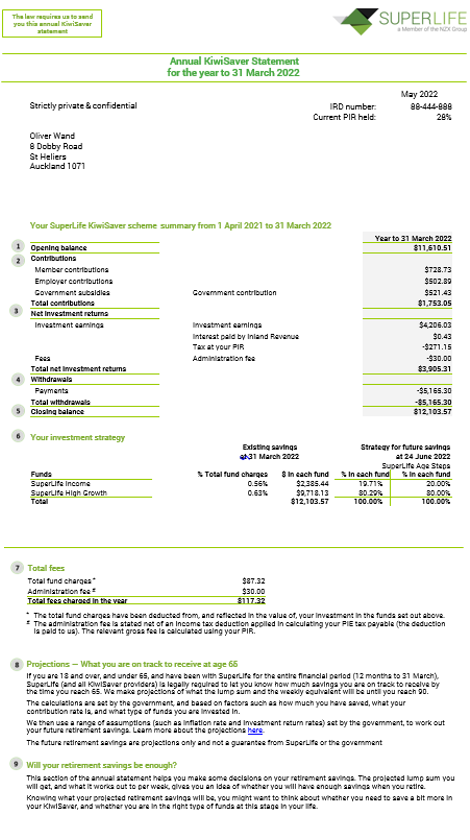
This shows how much you had in your KiwiSaver account at the start of the financial year or the date you became a member, whichever is later.
This shows your contributions, and any employer and government contributions you may have received. If you transferred into the scheme during the year, your transferred balance will show here as well. Find out more about contributing to KiwiSaver, what your employer’s obligation is, and what the government will contribute to your KiwiSaver.
Your investments are taxed at the prescribed investor rate (PIR) you have provided us. The PIR we hold for you is shown in the top right-hand corner of this statement. Make sure your PIR is correct. If you used a PIR lower than your correct rate, you need to include the income, and any tax paid, in your income tax return. If you are not sure whether you need to file an income tax return, please consult your accountant or tax adviser. You can work out your PIR here. If you are unsure of your PIR, you should seek independent professional advice from a tax adviser or speak to Inland Revenue.
This shows how much you have withdrawn from your account. This could be for retirement, a first home purchase, or for other approved early withdrawals.
This shows how much you had in your KiwiSaver account at the end of the financial year.
This shows how your money was invested at the end of the financial year, and the future investment strategy you have chosen. This also shows the total fund charges for each of your funds as a percentage of the fund’s investment value.
The total fees charged for the year are made up of an administration fee (if any) and fund charges. If you were involuntarily transferred in from another scheme as a default member, you were not charged any administration fee if you have all your money in the SuperLife Default Fund. However, there was a transaction cost associated with the transfer into the SuperLife KiwiSaver scheme. The fund charges cover our manager’s fee and other management and administration charges (supervisor, audit and legal costs). Your investment earnings are after the total fund charges. The fees set out above include the GST where applicable. You will only be charged the financial adviser fee if you have a financial adviser and have agreed with your adviser that he/she will be paid a fee for providing you financial advice. The amount of this fee is agreed between you and your financial adviser.
If you are 18 and over, and under 65, and have been with SuperLife for the entire financial period (12 months to 31 March), SuperLife (and all KiwiSaver providers) is legally required to let you know how much savings you are on track to receive by the time you reach 65. We make projections of what the lump sum and the weekly equivalent will be until you reach 90. The calculations are set by the government, and based on factors such as how much you have saved, what your contribution rate is, and what type of funds you are invested in. We then use a range of assumptions (such as inflation rate and investment return rates) set by the government, to work out your future retirement savings. Learn more about the projections here. The future retirement savings are projections only and not a guarantee from SuperLife or the government.
This section of the annual statement helps you make some decisions on your retirement savings. The projected lump sum you will get, and what it works out to per week, gives you an idea of whether you will have enough savings when you retire. Knowing what your projected retirement savings will be, you might want to think about whether you need to save a bit more in your KiwiSaver, and whether you are in the right type of funds at this stage in your life. |
 |
You might have noticed the new homepage, updated design across the site, or change to the navigational structure. You can take a closer look at some of the changes below. We value your feedback so please share your thoughts with us. You can do so by clicking here or the “Feedback” link at the top of any page.
-- content here --
-- Block start --
Use our Quick Links widget anywhere on the site to quickly view the returns and fees for all of our investment options and schemes, read our updated frequently asked questions on a broad range of investment topics, or invest on behalf of a child.
-- Block end --
-- Block start --
A clean, mobile-responsive design means you can easily access important information, such as your investment options or our educational resources, on any device at home or on the go.
-- Block end --
-- Block start --
Not sure where to start when it comes to joining SuperLife or choosing your investment options? Read our Help Me Choose page, which includes important information to get started, or leave us a note on any topic and our team will get in touch.
Tailored Workplace Savings Scheme to help your employees save for retirement.
Smart Exchange Traded Funds (ETFs) offer flexibility, global reach, and options to suit different goals and risk levels.
How can we help?
